Bee
Grey BeesHoneybees in the novel are not simply a beekeeper’s property or a ready-made metaphor for human society: they are living dependents whose needs organize Sergey Sergeyich’s days, determine his movements, and expose the costs of war in intimate, practical terms. Their warmth, work, and vulnerability offer a counterpoint to the violence around them, while their own social behavior gives Sergeyich a way to think about human life—often to humanity’s disadvantage.
Identity and Place in the Story
The bees belong to Sergey Sergeyich, a disabled pensioner and devoted beekeeper from Little Starhorodivka, one of the last residents to remain in a village emptied by fighting. As the war’s early fear gives way to confusion and indifference, his sense of responsibility survives in concentrated form: it is directed toward the bees. Their winter safety becomes the daily concern around which his remaining life is ordered.
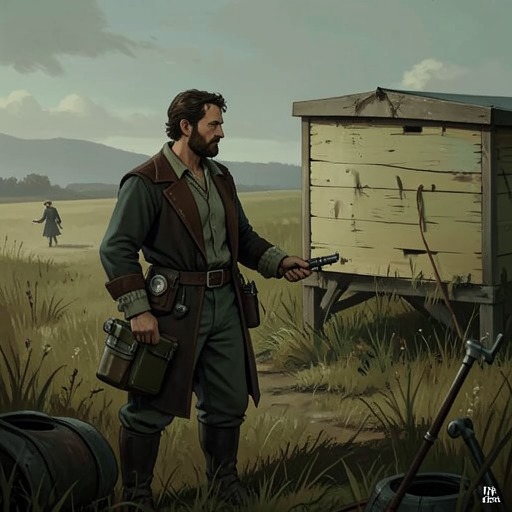
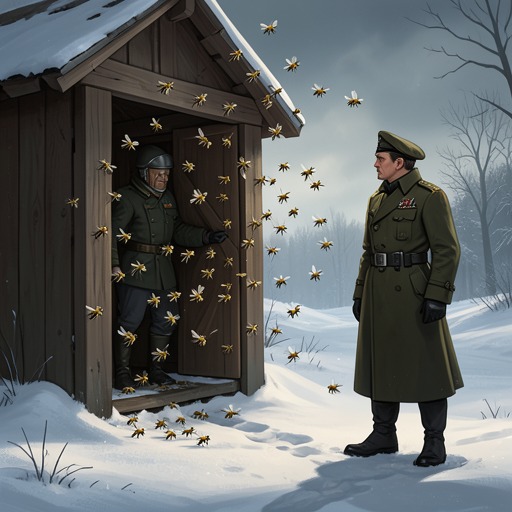
In the first winter scenes, the hives are lined with felt and covered by sheets of metal, then kept inside a shed exposed to the danger of shells coming from either side. Sergeyich worries that shrapnel might cut the metal but fail to pierce the wooden walls—or might not. The uncertainty is modest in scale but absolute in its stakes: a stray shell need not hit a person to endanger the life he has undertaken to protect.
The bees are also part of the book’s account of ordinary people in Donbas. Sergey Sergeyich belongs to the people who remain inconspicuous amid war, and the bees share that marginal position in a different way: their survival depends on quiet, continuous care, not on military power or public recognition. The novel’s focus on them shifts attention from combatants and operations to the vulnerable lives and routines that war presses upon without making them its declared subject.
Winter Care and the Work of Keeping Life Going
Sergeyich checks the bees every day and explains that the shed need not be heated: the bees keep their hives at about thirty-seven degrees themselves. They cannot simply sleep through winter; if they stopped generating warmth, they would freeze. Their heat is collective and self-maintained, but it does not make them independent of care. Sergeyich still tends the stove and protects the hives, linking their survival to his own continued capacity to work.
His attention to the colony is precise and physical. In the quiet yard, he moves the protective metal aside and presses his ear to a hive. He hears no sound, but feels the wall tremble. To him the hive’s wall is like an eardrum turned inside out: vibration registers as the life within. He replaces the metal sheet and murmurs that the bees will soon be working again. This small act makes care a practice of listening and touch, rather than a claim to command them.
That dependence runs both ways. When Sergeyich falls ill, he tends to himself as though he were his own patient and healer, but his reason for preserving his health reaches beyond self-preservation. If he died, he believes, the bees would perish in their multitude; the loss of hundreds of thousands of bee-souls would become a burden he could not escape even in the afterlife. The novel renders this fear as an ethical responsibility, not as a casual worry about a livelihood. His survival matters to him partly because so many other lives depend on it.
The seasons give this labor its rhythm. In February, the alarm clock’s ticking marks time toward March, when the first bees will make short reconnaissance flights over still-bare ground. They will not yet travel far; they will stretch their capacity for flight and renew their sense of the land while the hives stand in the sun to shed winter damp. Sergeyich imagines the coming buzz making the world feel smaller, cosier, and more like home. Spring does not end the war, but its sounds and smells can make distant explosions seem less important, and the renewal of natural life becomes a countermeasure to wartime numbness.
Work, Migration, and Human Dependence
When spring arrives, Sergeyich imagines releasing his bees into flowering fields as though deploying six regiments. The military comparison rises from the language and habits of a landscape at war, but it also transforms the image: these regiments are sent not to fight, but to gather nectar and pollen. For Sergeyich, a hive can be understood as both a regiment and a barracks, yet the bees’ actual purpose is not military. Their work follows the flowering land and the needs of the colony.
The contrast becomes especially sharp when Sergeyich plans to leave Little Starhorodivka if the war continues into spring. He intends to leave the village to Pashka and take all six hives somewhere without war, where fields are not pocked with craters but covered in buckwheat or wildflowers, and where a person can walk through woods and meadows without fear. He wants the bees to have forage, and himself to find a place where life feels warmer among other people. The proposed journey is not an escape from responsibility: he plans to carry that responsibility with him.
Preparing the hives for the road requires careful attention to the bees’ physical condition. Sergeyich will close their entrances to stop them scattering, load the hives one by one onto a flatbed trailer, cover them with a tarpaulin against the rain, and strap them securely. He also packs jars of honey, which he regards as a store of value that holds steady whether it is made from buckwheat or mixed grass. Weather matters as much as planning: a bumpy journey can agitate bees and raise the temperature inside their hives, so warmth outside would require night driving. Around ten degrees, with rain cooling the air, makes the trip safer. The apparent practical detail—when to drive, how to cover the hives—reveals that displacement is a shared physical ordeal, with conditions for the bees shaping the human journey.
Once the bees are established away from the village, their care continues to join work and subsistence. Sergeyich watches over their health, drives out wasps that try to enter the hives, uncaps honeycombs with a metal scraper, and collects honey, wax, and bee pollen. Their activity supports his livelihood, but he does not present himself as the author of their work: most of it is done by the bees, who neither ask his advice nor need his permission. His role is to protect their health and gather products without claiming to direct their internal lives.
Honey also creates a channel of mutual exchange with Galya. She proposes groceries in payment for the honey so Sergeyich can feed himself; later, her claim that it is anti-alcoholic proves successful in neighboring villages. The money she earns helps him look to the future with more confidence, while he continues to visit for water, meals, and supplies. When the first credit runs out, she pays cash in advance, but their relationship remains warm and friendly rather than becoming merely commercial. The honey is a commodity and a means of survival, yet its exchange also sustains a personal connection.
Colony Life and Human Comparisons
Sergeyich observes the bees’ social order closely, but draws a boundary around what belongs to them. The relations between workers and drones, with their everyday conflicts, are their own business, just as human relationships are people’s own concern. He intervenes for the colony’s health, not to reorganize it according to his preferences. Queens live, reproduce, and die in the natural course, with replacements born in the same hives; Sergeyich’s particular concern is the unexpected loss of a queen. This distinction between care and control is central to his bond with the bees.
The novel makes that boundary complicated rather than absolute. Watching bees at the hive entrance, Sergeyich becomes absorbed in the stream of arrivals: pollen-bearing workers land, sometimes awkwardly pushing past others who linger. He can imagine recognizing individual faces. When guards drive weakened drones from the hive before cold weather, he sees them being denied food, shoved out of the entrance, and left on the grass. One drone is already motionless and grey. Sergeyich interprets the scene through the language of work and class: workers gather pollen and build combs, while drones consume; the colony expels those it cannot afford to sustain.
His comparison is explicitly a human interpretation of observed bee behavior, not a claim that people and bees are governed by identical rules. What fascinates him is nature’s apparent wisdom, which he believes human life repeatedly fails to match. The drone scene makes that judgment vivid, but also shows how readily an observer can read social and political categories into animal life. The colony remains a colony with its own needs; the analogy reveals Sergeyich’s habits of thought as much as it explains the bees.
Swarms, Loss, and Narrative Significance
The bees’ lives are not always secured by careful husbandry. When a swarm gathers on a pear tree’s trunk, Sergeyich tries to prevent it from escaping. He mists the bees from below with water, making droplets cling to their wings and quieting the buzzing. He then climbs only two rungs up a ladder, braces a trap between his stomach and the trunk, and sweeps the swarm into it with a dustpan. Nearly all enter in two trembling clusters; the few remaining bees crawl down after them, unwilling to be separated from the swarm and its queen. He watches them descend before covering the trap and carrying it back to the empty hive. His restraint and concern are practical: the aim is not to overpower the bees but to gather them without losing their collective life.
That effort has a darker counterpoint in the destruction of the third hive by a grenade. The explosion presses Sergeyich’s face into the dry black earth; above him, a whistle mingles with buzzing, and something wet lands on his head. When he rises, the ground sways. In the place where the hive stood there is only a crater, scattered wood, and a fragment of comb. A bee still flies past. The remaining life does not make the destruction less complete; it makes the contrast harder to ignore. War reaches the bees not as an abstraction or a metaphor, but through the obliteration of a hive and the vulnerability of the creatures around it.
Across these episodes, the bees acquire narrative presence through their own rhythms and needs: winter heat, brief spring flights, foraging, swarm cohesion, and the colony’s changing membership. The novel also allows them to carry meaning—as a measure of Sergeyich’s responsibility, a reason for flight, an economic support, and a standard against which he judges human behavior. Those meanings do not exhaust them. Their independence from his advice, their bodily vulnerability to weather and explosives, and their collective life remain concrete realities. In a story about war’s encroachment on ordinary existence, the bees make survival visible as a shared, sustained practice rather than a heroic abstraction.